1. What Is Split Fiber Laser Marking Technology
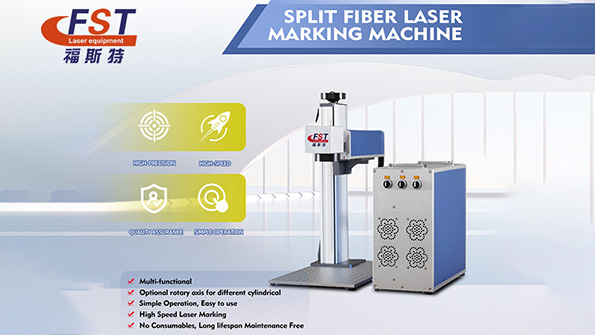
A split fiber laser marking machine is an upgraded flexible laser marking device designed for complex working conditions and automated production lines. Different from traditional integrated marking machines, it adopts a separated structure with independent laser host, control system and marking head. The equipment converts electric energy into stable fiber laser energy, and transmits the laser beam through flexible optical fiber to complete high-precision surface etching, pattern engraving and data coding.
Equipped with high-speed galvanometer scanning and intelligent control system, Xianming split fiber laser marker supports fine marking, dynamic variable data coding and long-term batch production. It solves the space and scenario limitations of integrated marking equipment and realizes more flexible industrial marking.
Core marking processing types:
• Permanent brand LOGO and pattern marking
• Dynamic QR code, barcode and serial number coding
• Parameter text, specification and production information engraving
• Anti-counterfeiting code and fine character marking
• Large-area and multi-station synchronous marking
Core application values:
• Fadeless and wear-resistant permanent identification
• 0.01mm ultra-high precision processing capability
• Flexible adaptation to narrow stations, large workpieces and assembly lines
• Zero consumable, environmentally friendly and pollution-free processing
• Unmanned batch marking for automated production
2. Main Processing Workpieces and Scenarios
Split fiber laser marking machines are widely used for precision industrial part marking. The separated structure breaks the size limitation of integrated machines, making it ideal for large workpieces, irregular parts and online assembly line marking. It supports both fixed single-piece processing and dynamic follow-up marking, fully meeting customized and mass production demands.
Stable processing capabilities:
• Free switching between fixed marking and flexible mobile marking
• Ultra-clear patterns and text forming without blurring or edge deviation
• Effective marking for oversized and special-shaped workpieces that integrated machines cannot handle
• Highly consistent batch marking to ensure unified product identification standards
Compared with inkjet printing and integrated laser marking, split laser marking avoids fuzzy marks, easy fading and space restrictions, ensuring stable traceability quality for long-term industrial production.
3. Applicable Processing Materials
Xianming split fiber laser marking machine features strong material compatibility, covering most metal materials and common engineering plastics for industrial manufacturing.
Carbon Steel & Stainless Steel
Delivers uniform, high-contrast and wear-resistant marking results without damaging the base material. Widely used for hardware parts, standard components and mechanical tools.
Aluminum Alloy & Anodized Aluminum
Optimized laser beam technology realizes stable black marking on aluminum surfaces, solving the difficulty of low-contrast aluminum marking. Suitable for automotive parts and electronic shells.
Copper & Brass
Achieves fine and clear marking on high-reflection metal surfaces with no surface damage, ideal for conductive accessories and precision hardware.
Galvanized & Coated Plates
Completes high-quality marking without peeling or damaging surface coatings, ensuring stable anti-corrosion performance of workpieces.
Engineering Plastics
Supports precise marking on ABS, PVC and nylon materials with smooth edges and no melting deformation, perfect for electronic plastic shells and daily plastic products.
4. Core Advantages of Split Laser Marking
Flexible Split Structure, No Space Limitation
Different from integrated machines limited by cabinet size, the split design separates the host and marking head. The independent marking head can extend into narrow stations, assembly lines and complex tooling positions to complete marking, realizing diversified processing scenarios unavailable for traditional integrated equipment.
Independent Heat Dissipation, Long-term Stable Operation
The independent host structure optimizes heat dissipation efficiency, effectively avoiding laser power attenuation and marking deviation caused by long-hour operation. It supports 24-hour continuous industrial production with stable output quality.
High Compatibility with Automated Production
Reserved automation interfaces allow seamless connection with assembly lines, rotary tables and robotic arms. It realizes fully automatic unmanned marking and greatly improves factory production efficiency.
Low Operating Cost & Zero Consumables
Fiber laser marking requires no ink or chemical consumables. The laser source service life exceeds 100,000 hours, with low failure rate and minimal maintenance cost, helping enterprises reduce long-term production expenses.
Modular Design for Easy Maintenance
Independent modular structure simplifies daily inspection and component replacement. It avoids overall equipment shutdown caused by partial failure and improves factory operating efficiency.
5. Industrial Application Industries
Thanks to its flexible structure and stable performance, split fiber laser marking equipment is widely adopted in precision manufacturing industries:
• Hardware tools and standard parts manufacturing
• Automotive parts and new energy accessories
• Electronic components and electrical equipment
• Precision machinery and instrumentation
• Architectural hardware and pipeline accessories
• Plastic products and daily necessities
• Jewelry, crafts and customized metal parts
• Assembly line online coding and product traceability
6. Conclusion
As manufacturing industries continue to pursue intelligence, automation and full-process traceability, split fiber laser marking has become an essential solution for modern industrial identification. Breaking the space and scenario limitations of traditional integrated marking machines, it provides flexible, high-precision and permanent marking for complex workpieces and automated production lines. It effectively helps manufacturers improve product quality, realize intelligent traceability and reduce production costs. With continuous technical optimization, split fiber laser marking equipment will further replace traditional marking processes and become standard configuration for high-end intelligent factories.
If you need flexible and high-stability laser marking solutions for automated production, welcome to visit Xianming Laser official website to view marking samples and technical parameters. Send your workpiece materials and processing requirements to get a customized industrial marking proposal.
Post time: Jun-18-2026

