With the continuous advancement of laser processing technology, bevel cutting has gradually expanded from traditional plate welding applications to various metal tubes, structural profiles, and complex special-shaped components. Compared with conventional cutting methods, laser bevel cutting not only provides higher-precision weld preparation but also significantly improves welding quality, assembly efficiency, and overall structural strength.
So, what types of materials and tubes are suitable for bevel cutting? What are the processing characteristics of different tube structures in bevel machining? This article provides a comprehensive analysis from the perspectives of industrial applications, tube categories, and processing advantages.
What Is Bevel Cutting?
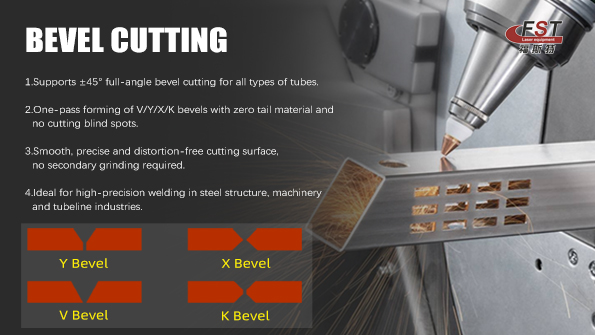
Bevel cutting refers to a machining process in which the cutting angle is controlled to create an inclined surface along the edge of a workpiece during laser metal material cutting.
Common bevel types include:
V-bevel
Y-bevel
X-bevel
K-bevel
U-bevel
The primary purposes of bevel cutting are:
Increasing weld penetration depth
Enhancing welding strength
Reducing welding defects
Improving structural stability
Lowering post-processing costs
In modern laser processing, bevel cutting is typically performed by five-axis or multi-axis laser cutting systems, enabling high-precision, multi-angle, and complex contour automated processing.
What Types of Tubes Can Be Processed with Bevel Cutting?
Round Pipe Bevel Cutting
Round pipes are among the most common bevel cutting applications and are widely used in:
Oil and gas pipelines
Steel structure engineering
Pressure vessels
Construction machinery
Fire protection pipeline systems
Laser bevel cutting for round pipes can achieve:
Pipe-end bevel cutting
Intersecting line bevels
Multi-angle welding joints
High-precision connection structures
Compared with traditional methods, laser cutting ensures better end-face flatness and welding consistency.
Square and Rectangular Tube Bevel Cutting
Square and rectangular tubes are widely used in:
Building steel structures
Curtain wall engineering
Mechanical frames
Automation equipment
Due to their multiple edges and corner transitions, these profiles require highly accurate cutting trajectory control.
Laser bevel cutting can achieve:
Continuous multi-edge beveling
Seamless corner transitions
High-precision weld preparation
One-step integrated processing
This technology is especially suitable for high-end steel structure welding and large-frame manufacturing.
H-Beam Bevel Cutting
H-beams are heavy-duty structural profiles that require extremely high welding strength.
Traditional processing methods typically involve:
Flame beveling
Secondary grinding
Multiple processing steps
Laser bevel cutting can directly achieve:
Flange bevel cutting
Web bevel cutting
Multi-angle compound bevels
High-precision welding interfaces
This significantly improves the processing efficiency of heavy steel structures.
Main application fields include:
Bridge engineering
Heavy steel structures
Large industrial plants
Offshore platforms
Channel Steel, Angle Steel, and I-Beam Bevel Cutting
Complex structural profiles feature irregular cross-sections and require advanced dynamic control capabilities from the laser equipment.
Laser bevel cutting systems can achieve:
Simultaneous multi-surface cutting
Complex contour bevel processing
Automatic path compensation
High-consistency batch production
These applications are widely used in:
Power transmission towers
Engineering support structures
Building framework systems
Special-Shaped Tube Bevel Cutting
With the increasing demand for customized manufacturing, more special-shaped tubes are being used in industrial production.
These include:
Oval tubes
Hexagonal tubes
D-shaped tubes
Automotive special structural components
Customized metal profiles
Traditional processing methods struggle to maintain precision on complex curved surfaces, while multi-axis laser bevel cutting can achieve:
3D dynamic cutting
Curved surface bevel processing
High-precision automatic compensation
One-step complex contour forming
These applications are widely used in:
Automotive manufacturing
Fitness equipment
Furniture production
Decorative engineering
What Materials Are Suitable for Bevel Cutting?
Modern laser bevel cutting equipment can process a wide range of metallic materials, including:
Carbon Steel
Suitable for heavy structural fabrication and thick-plate welding applications.
Stainless Steel
Ideal for high-precision and high-cleanliness welding environments.
Aluminum Alloy
Widely used in lightweight structures and new energy vehicle manufacturing.
Galvanized Steel
Commonly applied in construction and ventilation duct systems.
Copper and Brass
Suitable for high-conductivity and precision component manufacturing.
Advantages of Laser Bevel Cutting Compared with Traditional Processing
One-Step Forming with Reduced Secondary Processing
Traditional methods usually require additional grinding and bevel preparation after cutting, while fiber laser systems can complete cutting and beveling simultaneously.
Higher Welding Quality
High-precision bevel geometry improves weld fusion quality and reduces welding defects.
Improved Production Efficiency
Automated processing minimizes manual intervention and is ideal for continuous mass production.
Reduced Material and Labor Costs
Precise cutting minimizes material waste while reducing grinding and finishing processes.
Suitable for Complex Structural Processing
Multi-axis linkage systems can easily complete complex bevel structures that are difficult to achieve using conventional methods.
Typical Industries for Laser Bevel Cutting Applications
Laser bevel cutting is widely used in:
Steel structure manufacturing
Construction machinery
Shipbuilding
Bridge construction
Automotive manufacturing
Pressure vessels
Oil and gas pipelines
Fitness equipment manufacturing
Metal furniture production
Offshore engineering
Conclusion
As industrial manufacturing continues to evolve toward higher precision, efficiency, and intelligent automation, bevel cutting has become an essential process in modern metal fabrication. Whether processing round pipes, square tubes, H-beams, or complex special-shaped profiles, advanced laser bevel cutting technology enables high-quality and highly efficient automated manufacturing.
Post time: May-28-2026

