As the metal processing industry continues to demand higher production efficiency and improved material utilization, “zero tail material cutting” has gradually become an important technological direction in the field of laser tube cutting equipment.
So, what exactly is “zero tail material cutting”? Can it truly achieve completely “zero waste”?
What Is Zero Tail Material Cutting?
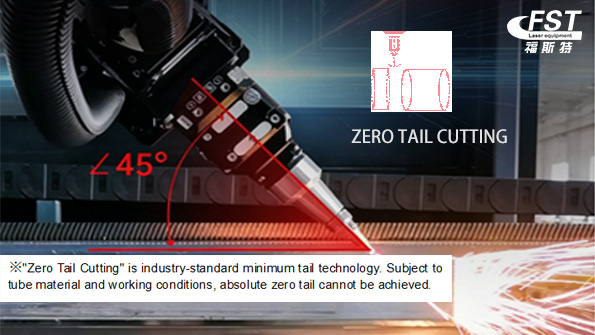
“Zero tail material cutting” refers to an advanced laser tube cutting technology that minimizes the remaining tail material after processing through optimized machine structure, intelligent feeding systems, and coordinated chuck control technology.
In traditional tube cutting processes, due to limitations related to front and rear chuck clamping, feeding stroke distance, and machine structure, a certain length of tube material usually remains unprocessed at the end of the cutting process. Although the remaining material may appear minimal, it can lead to significant material waste during large-scale production.
By optimizing cutting logic and machine movement coordination, zero tail material cutting technology maximizes the utilization of the entire tube, helping manufacturers effectively reduce raw material costs and improve overall production efficiency.
Why Are More Manufacturers Focusing on Zero Tail Material Technology?
In the metal tube processing industry, raw material costs account for a significant portion of overall manufacturing expenses. Especially when processing high-value materials such as stainless steel, aluminum, and copper, tail material control directly impacts profitability.
Compared with conventional tube cutting methods, zero tail material cutting technology offers several advantages:
Improved material utilization and reduced waste
Lower long-term production costs
Higher automation and processing efficiency
Reduced manual intervention and secondary operations
Enhanced continuous processing stability
Better suitability for mass production and intelligent manufacturing
As a result, “zero tail material” capability has become one of the key indicators for evaluating the performance of high-end laser tube cutting machines.
Does “Zero Tail Material” Really Mean Completely Zero Waste?
It is important to clarify that the term “zero tail material cutting” in the industry mainly represents a high-standard tail material control concept rather than absolute zero waste in the strict sense.
In actual processing applications, achieving truly complete zero tail material is nearly impossible due to several influencing factors:
Tube Material Differences
Different tube materials have varying hardness, deformation characteristics, and stability during processing, which directly affect clamping and feeding accuracy.
Variations in Tube Diameter and Wall Thickness
Different specifications of round tubes, square tubes, and special-shaped tubes create varying center-of-gravity and stress conditions, increasing the complexity of tail material control.
Chuck Clamping Requirements
To ensure processing stability during high-speed cutting, the machine must reserve a certain clamping area, making it impossible to eliminate tail material entirely.
Processing Conditions
High-speed cutting, heavy tube processing, and complex pattern cutting require higher machine stability, which can also influence tail material length.
Therefore, the industry generally regards “ultra-short tail material” or “near-zero tail material” as a reflection of advanced laser tube cutting technology and machine performance.
Foster Laser Zero Tail Material Cutting Solution
To meet the market demand for higher material utilization, Foster Laser continuously optimizes the structure and intelligent control systems of its laser tube cutting machines. Through high-precision chuck design, intelligent feeding control, and automated cutting algorithms, Foster Laser effectively reduces tail material length while maximizing tube material utilization.
At the same time, the laser equipment maintains both high-speed cutting stability and precision processing performance, making it suitable for a wide range of metal tube processing applications and providing customers with more efficient, material-saving, and intelligent manufacturing solutions.
Conclusion
As the manufacturing industry continues to develop toward automation, intelligence, and precision production, zero tail material cutting technology is becoming an important trend in the laser tube cutting industry. For manufacturers, higher material utilization not only reduces production costs but also enhances market competitiveness.
In the future, Foster Laser will continue to focus on laser tube cutting technology innovation, continuously improving machine performance and intelligent manufacturing capabilities to provide global customers with more efficient, stable, and material-saving laser processing solutions.
Post time: May-28-2026

