
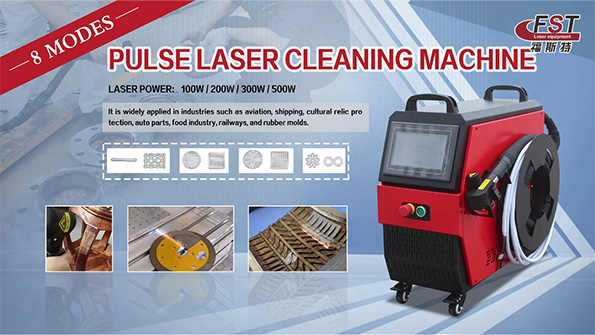
In the field of industrial and daily cleaning, pulse cleaners and continuous cleaners are two widely applied technologies. There are significant differences between them in terms of working principle, cleaning effect and applicable scenarios. Among them, pulse laser cleaners have become the preferred choice for various special scenarios due to their advantage of not damaging the base material.
From the perspective of working principle, the core difference between the two lies in the energy output method. Continuous laser cleaning machine adopt a mode of continuous energy output, where the laser machine or cleaning medium acts on the surface of the base material at all times. The long-term accumulation of energy is likely to generate excessive temperature, which in turn leads to damage such as deformation, discoloration and microcracks on the base material, making them particularly unsuitable for sensitive materials. In contrast, pulse cleaners work in the form of intermittent and controllable energy pulses. The energy is concentrated and the action time is extremely short, which can instantly vaporize or peel off contaminants, and hardly conduct heat to the inside of the base material, fundamentally avoiding damage to the base material.
In terms of applicable scenarios, this difference is more prominent. Continuous cleaners are more suitable for extensive cleaning with low requirements on the durability of the base material, such as derusting of ordinary metal components and paint stripping of large-area rough surfaces. However, they have obvious limitations and cannot be used for cleaning precision or fragile items.
With the advantage of non-destructiveness, pulse cleaners are suitable for a variety of special and precise cleaning needs. For precious cultural relics, they can gently remove dust, stains and aged attachments on the surface without damaging the material and texture of the cultural relics themselves, maximizing the preservation of the integrity of the cultural relics, and thus are ideal tools in the field of cultural relic restoration. In the cleaning of wall graffiti, they can accurately peel off graffiti paint without damaging the original paint or masonry structure of the wall, avoiding secondary damage to the wall caused by traditional cleaning methods. In addition, they are also suitable for the cleaning of easily damaged items such as precision molds, electronic components and wooden furniture, balancing cleaning effect and base material protection.
In summary, the core difference between pulse cleaners and continuous cleaners lies in the base material protection ability brought by the energy output method. With its non-destructiveness and precision, pulse cleaners show an irreplaceable advantage in fine cleaning scenarios, while continuous cleaners are more suitable for extensive cleaning needs.
Post time: Apr-24-2026

