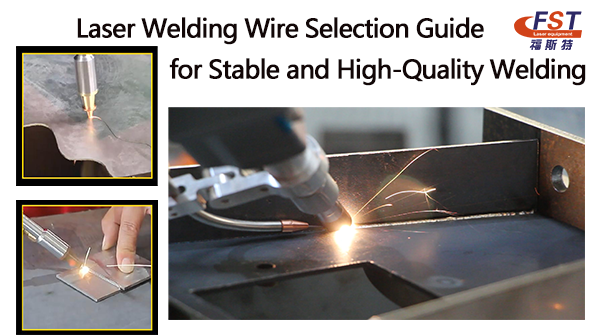
In laser welding applications, many users tend to focus primarily on laser power, welding heads, and system configuration, while overlooking another equally critical factor — the selection
of welding wire.
In fact, the material, diameter, and compatibility of the welding wire directly affect weld bead formation, joint strength, surface appearance, and overall process stability.
As a laser equipment manufacturer with many years of experience in the laser welding industry, Foster Laser has accumulated extensive application expertise and developed a mature and
reliable welding wire selection methodology, helping customers achieve higher welding quality and greater process consistency.
First The Role of Welding Wire in Laser Welding
In laser welding processes — especially laser filler wire welding — the welding wire plays several essential roles:
Supplementing molten metal to improve joint strength
Enhancing weld bead formation and reducing defects such as underfill and lack of penetration
Adjusting metallurgical properties to meet requirements for corrosion resistance, strength, and toughness
Increasing process tolerance to accommodate joint gaps and assembly deviations
During the design of its laser welding machines, Foster Laser has carried out extensive optimization of wire feeding stability and melt pool matching, enabling the welding wire to fully
perform its intended functions.
Second Principles for Selecting Welding Wire Materials
2.1 Matching the Welding Wire to the Base Material
This is the most fundamental and critical principle. General recommendations include:
Stainless steel welding: Use stainless steel filler wires (e.g. 304, 316 series)
Carbon steel welding: Use low-carbon steel or alloy steel filler wires
Aluminum alloy welding: Use aluminum filler wires such as 4043 or 5356
Dissimilar metal welding: Select transition-type filler wires based on base materials and service conditions
In real-world projects, Foster Laser evaluates material composition and application requirements to recommend optimal welding wire combinations, avoiding improper selection that may
compromise weld performance.
2.2 Considering Service Environment and Performance Requirements
Beyond base material compatibility, the service environment of the welded component must also be taken into account, such as:
Long-term exposure to humid or corrosive environments
Mechanical impact loads or high-temperature conditions
High aesthetic requirements for weld appearance
Under these conditions, the corrosion resistance, mechanical strength, and ductility of the welding wire become particularly important.
For high-end welding applications, Foster Laser often recommends premium-quality filler wires with stable performance to ensure long-term welding reliability.
Third Key Considerations for Welding Wire Diameter Selection
The welding wire diameter should not be selected arbitrarily. Neither thicker nor thinner wires are universally better — the diameter must be properly matched to the welding process
parameters.
Common selection guidelines include:
Thin plate welding (≤ 1.5 mm): 0.8 mm / 1.0 mm filler wire
Medium-thickness plates (2–4 mm): 1.0 mm / 1.2 mm filler wire
Thicker plates or high fill-volume applications: 1.2 mm / 1.6 mm filler wireThe wire feeding systems of Foster Laser welding machines are designed to support stable feeding of multiple
wire diameters. Wire feed speed can be synchronized with laser power to effectively prevent wire jamming, vibration, and melt pool instability.
Fourth Impact of Welding Wire Quality on Welding Performance
The importance of welding wire quality is often underestimated, yet it has a significant influence on welding results:
Poor surface cleanliness Increased risk of porosity
Inconsistent chemical composition Uneven weld strength
Poor roundness tolerance Unstable wire feeding
During customer training and equipment delivery, Foster Laser typically recommends the use of industrial-grade welding wires with stable composition and high surface cleanliness to fully
realize the performance advantages of laser welding equipment.
Fifth Matching Welding Wire with Laser Welding Equipment
Even high-quality welding wire may fail to deliver optimal results if it is not well matched to the laser welding equipment.
In the development of its laser welding machines, Foster Laser focuses on optimizing:
Wire feeding angle in alignment with the laser focal point
Coordinated control between wire feed speed and laser power
Preset welding parameters for different wire materials These optimizations ensure excellent weld bead appearance, stable penetration, and minimal spatter across a wide range of materials and
welding wire types.
Conclusion: The Right Welding Wire Makes All the Difference
Laser welding is not simply a matter of equipment specifications — it is the result of system-level coordination between the welding machine, filler wire, and welding process.
Selecting the correct welding wire not only improves weld quality but also reduces rework rates and increases overall production efficiency.
Foster Laser remains committed to application-driven solutions, providing not only reliable laser welding equipment but also professional support in welding wire selection, process
optimization, and operator training — helping customers achieve high-quality, efficient, and stable welding production.
Post time: Jan-27-2026

