
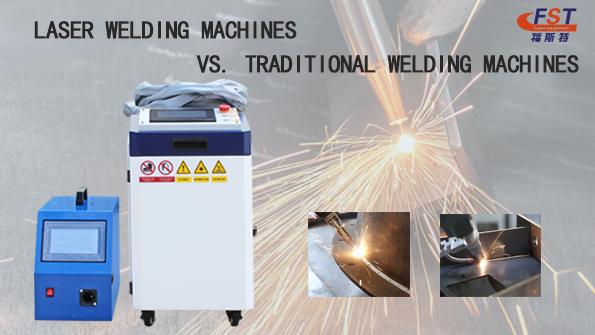
As the manufacturing industry continues to move toward higher precision, greater efficiency, and increased automation, welding processes are undergoing significant upgrades. As an advanced
welding technology, laser welding machines are gradually replacing certain traditional welding methods such as arc welding, TIG welding, and CO₂ welding. Significant
differences exist between the two in terms of working principles, weld quality, efficiency, and application scenarios.
I. Comparison of Welding Principles
Laser Welding Machines
Laser welding uses a high-energy-density laser beam as the heat source, concentrating energy into an extremely small area to instantly melt the material and form a weld seam. Heat input can
be precisely controlled, resulting in a stable welding process with excellent repeatability.
Traditional Welding Machines
Traditional welding methods typically rely on an electric arc or electrical current to generate heat, melting the base material through welding rods or filler wire. The heat source is more
dispersed and highly dependent on the operator’s skill level, leading to relatively lower consistency in weld quality.
II. Weld Quality and Precision
Laser Welding
Narrow, clean, and aesthetically pleasing weld seams
High depth-to-width ratio with controllable penetration
High weld strength with minimal deformation
Excellent repeatability, ideal for high-specification products
Traditional Welding
Wider weld seams
Larger heat-affected zones, prone to deformation
Weld quality highly dependent on manual operation
Extensive post-weld grinding and finishing often required
III. Welding Efficiency and Production Capacity
Laser Welding Machines
High welding speed, suitable for continuous and high-speed welding
Well suited for mass production and automated manufacturing
Easily integrated with robotic systems and production lines
Significantly improves overall production throughput
Traditional Welding Machines
Relatively slower welding speed
Primarily manual operation, with efficiency influenced by personnel
Limited automation capability
Better suited for small-batch production or simple structural components
IV. Heat-Affected Zone and Material Compatibility
Laser Welding
Small heat-affected zone
Highly suitable for thin sheets, stainless steel, aluminum alloys, and precision components
Capable of welding dissimilar metals (with appropriate process optimization)
Minimal post-weld deformation and excellent dimensional stability
Traditional Welding
Large heat-affected zone
Greater difficulty when welding thin materials
Higher likelihood of deformation after welding, requiring corrective processes
Limited suitability for high-precision components
V. Operation and Dependence on Manual Labor
Laser Welding Machines for metal
Standardized operation with digitally adjustable parameters
Lower dependence on operator skill level
Easier training and process replication
Consistent and stable welding results
Traditional Welding Machines
High reliance on operator experience and technical skill
Weld quality easily affected by human factors
Greater variability in welding stability
VII. Conclusion
From the perspective of manufacturing upgrades and long-term development, portable laser welding machines demonstrate clear advantages in welding precision, production efficiency,
and process stability. They are particularly well suited for industries that demand high weld quality, fast production cycles, and strict product consistency.
In this context, Foster Laser leverages its mature laser welding technology, reliable laser equipment performance, and application-oriented solutions tailored to real production conditions,
continuously supporting manufacturers in upgrading their welding processes and improving overall productivity.
At the same time, traditional welding machines still offer practical value in small-batch production, repair work, and cost-sensitive applications.
Overall, laser welding machines and traditional welding machines are not in a simple replacement relationship. The optimal choice should be made based on specific product structures,
production volumes, and process requirements to achieve the best balance between quality, efficiency, and cost.
Post time: Jan-10-2026

