In laser welding machine for metal processes, parameters such as power, welding speed, and oscillation settings often receive the most attention. However, one of the true factors that
defines the upper limit of welding performance is the laser focus position.
Whether the focus is set correctly has a direct impact on energy density, penetration depth, weld formation, and even the overall operational stability of the laser equipment.
Understanding and accurately controlling the laser focus is therefore fundamental to achieving high-quality laser welding.
I. What Is Laser Focus?
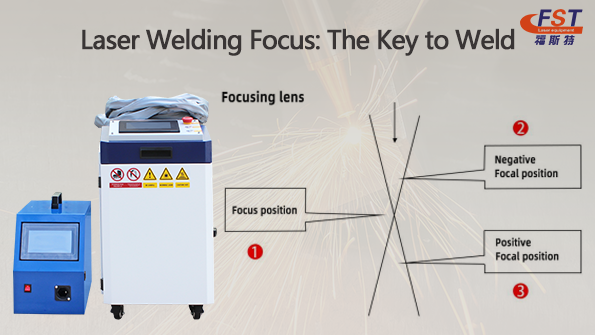
After passing through the focusing lens, the laser beam converges to a point in space where the energy is highly concentrated—this point is known as the laser focus.
Near the focal point, the laser beam exhibits the following characteristics:
Minimum spot size
Maximum energy density
Highest material absorption efficiency
For this reason, even a slight shift in focus position—by only a few millimeters—can result in a noticeable change in welding performance.
II. Three Common Focus States and Their Process Characteristics
Focus Position (Zero Defocus)
When the focal point is located directly on the workpiece surface or at the center of the welding zone, the laser energy is highly concentrated, providing the strongest penetration capability.
Characteristics:
Maximum energy density
Greatest penetration depth
Fast weld initiation and high efficiency
Typical Applications:
Welding processes with high penetration requirements
Thick materials or applications requiring rapid full penetration
When maximum energy utilization is required, the zero-focus position is often the preferred choice.
Negative Defocus (Focus Above the Workpiece)
When the focal point is positioned above the workpiece surface, the laser beam begins to diverge before reaching the material, resulting in a relatively larger spot size.
Characteristics:
More evenly distributed energy
Improved molten pool stability
Reduced penetration depth
Typical Applications:
Continuous deep-penetration welding
Processes demanding high welding stability and seam consistency
Thick-plate welding to reduce spatter and welding fluctuations
Negative defocus emphasizes stability and process controllability.
Positive Defocus (Focus Below the Workpiece)
When the focal point is positioned below the workpiece surface, the laser forms a larger spot on the surface, lowering the energy density per unit area.
Characteristics:
More uniform heat distribution
Smoother surface appearance
Shallower penetration depth
Typical Applications:
Thin-sheet welding
Surface sealing welds and lap welding
Applications with low penetration requirements but high demands on weld appearance
Positive defocus is commonly used in scenarios where surface quality and heat-affected zone control are critical.
III. Why Is Focus Control So Important?
Directly Determines Weld Penetration
The closer the focus is to the core welding zone, the higher the energy density and the greater the penetration depth.
Affects Weld Formation and Consistency
Excessive focus deviation can lead to uneven weld width and unstable seam formation.
Influences Welding Process Stability
Proper focus settings help reduce spatter, minimize welding fluctuations, and improve reliability in continuous welding operations.
Indirectly Impacts Equipment Service Life
Improper focus conditions may cause energy reflection and system alarms, which can negatively affect the long-term stability of optical and electrical components.
IV. Practical Recommendations for Focus Adjustment
In real-world applications, there is no universal focus setting. Focus adjustment should be determined based on a combination of factors, including:
Material type (stainless steel, carbon steel, aluminum alloy, etc.)
Material thickness
Welding configuration (butt welding, lap welding, fillet welding)
Matching of welding speed and laser power
It is recommended to determine the optimal focus position through trial welding before formal production and to maintain consistent settings during batch processing.
V. Conclusion
High-quality laser welding relies on precise understanding and control of the laser focus.
Focus adjustment is not simply a matter of alignment—it is a critical parameter that integrates energy management, process logic, and welding experience.
Only by mastering focus behavior can stable, efficient, and fully controllable metal laser welding machine results be achieved across different welding scenarios.
Post time: Feb-03-2026

