
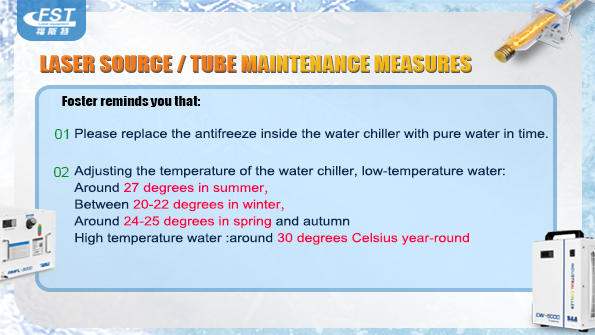
During winter low-temperature conditions, adding antifreeze to the chiller system is a necessary measure to ensure safe laser equipment operation. It effectively prevents water circuits from
freezing and protects heat exchangers and pumps from cracking or damage. However, as temperatures rise, continuing to use antifreeze for extended periods may introduce new operational
risks.
Therefore, when spring arrives, timely replacement of antifreeze with purified water or deionized water becomes a critical — yet often overlooked — maintenance step in laser equipment cooling
systems.
Why Must Antifreeze Be Replaced with Purified Water in Spring?
FIRST Antifreeze Is Not a Long-Term Operating Medium
The primary function of antifreeze is to lower the freezing point. Its chemical composition typically contains ethylene glycol, propylene glycol, and corrosion-inhibiting additives. When used for
extended periods under normal temperature conditions, these components may:
Increase the load on the cooling system and reduce heat exchange efficiency
Accelerate aging of pumps and sealing components
Create deposits that contaminate the water circulation system
For laser equipment that demands high stability and precision, antifreeze is not an ideal long-term cooling medium.
SECOND Purified Water / Deionized Water Is the Standard Cooling Medium
Under normal operating temperatures, chillers should use:
Purified Water (RO Water)
Deionized Water (DI Water)
These types of water offer the following advantages:
Contain only water molecules with minimal mineral ions
Free of impurities, sediment, and scaling risks
Low electrical conductivity for safer and more stable operation
Tap water, mineral water, or groundwater must never be used, as they can easily cause scale buildup, reduce cooling efficiency, and potentially damage the laser source.
THIRD Clean Water Is Essential — But Not Just Any Water
A common misconception among users is:
“Any water will work.”
In reality, chiller systems contain metal piping, pumps, and sensors. Impurities, dissolved ions, or abnormal conductivity levels can introduce significant operational risks.
Although purified or deionized water has very low conductivity, once contaminated with impurities, conductivity increases — potentially compromising system stability.
Therefore, water purity is more important than simply using water.
Recommended Replacement Procedure (Brief Overview)
1.Power off and disconnect the equipment to ensure safety
2.Completely drain antifreeze from the chiller and circulation system
3.Flush the system at least once using purified water
4.Refill with fresh purified water or deionized water
5.Check water level, flow rate, and alarm status
If the metal laser equipment has been idle for a long period or operates in a complex environment, replacement should be performed by qualified professionals.
A Small Maintenance Step That Extends Equipment Lifespan
The chiller is the “lifeline” of soldadora laser . Proper water quality management directly affects:
Laser source stability
Cutting and welding quality
Overall equipment lifespan
After-sales maintenance costs
Adding antifreeze in winter and switching back to purified water in spring is not optional — it is a standard maintenance practice.
When done correctly, it ensures stable, reliable equipment performance throughout the entire year.
Post time: Feb-20-2026

