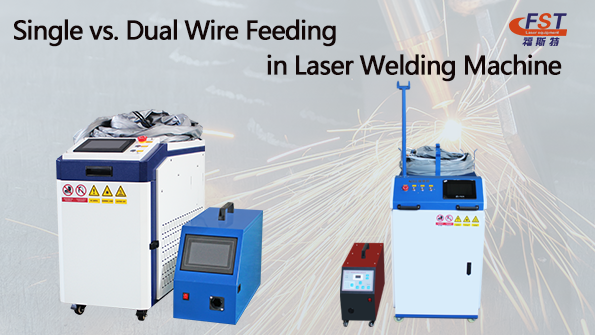
The right configuration can double welding efficiency and weld quality
In practical laser welding applications, many users face a seemingly simple yet highly critical question:
Should you choose single wire feeding or dual wire feeding?
This configuration choice should never be underestimated, as it directly affects welding efficiency, weld bead formation quality, and ultimately the overall return on investment of the
equipment.
First Single Wire Feeding: A Stable and Cost-Effective All-Round Solution
Single wire feeding metal laser welding systems feature a relatively simple structure with a clear and smooth wire feeding path, making them easy to operate and control. They are
particularly suitable for thin sheet welding, standard weld seams, and conventional production scenarios.
Key advantages include:
Stable wire feeding with high consistency in weld bead formation
Simple system structure with low maintenance requirements
Operator-friendly design with a short learning curve
High cost-effectiveness, ideal for small and medium-sized fabrication businesses
For common materials such as stainless steel, carbon steel, and galvanized steel, single wire feeding systems can fully meet the requirements of most welding machine aluminum laser
processes.
Second Dual Wire Feeding: An Advanced Solution for High-Demand Applications
When higher requirements are placed on weld metal deposition, bead fullness, or overall welding efficiency, dual wire feeding systems offer clear advantages.
The value of dual wire feeding lies in:
Synchronous or independent wire feeding for enhanced filling capability
Fuller, smoother weld beads with improved transition appearance
Ideal for thick plates, large joint gaps, and complex weld structures
Higher welding speeds, well suited for mass and high-efficiency production
In applications such as construction machinery, structural sheet metal, and non-standard custom fabrication, dual wire feeding systems can significantly improve both welding quality and
production throughput.
Third Selection Is Not About “More,” but About “Right”
There is no absolute superiority between single and dual wire feeding systems. The key lies in how well the configuration matches your specific application requirements.
An incorrect selection may increase costs and compromise welding stability, while the right configuration enables laser welding technology to deliver its full performance potential.
Fourth Foster Laser: Making Every Wire Feeding Solution More Reliable
As a professional brand deeply rooted in the laser equipment industry, Foster Laser adheres to the design philosophy of “stability first, process-oriented solutions” in the development of
laser welding wire feeding systems.
Single wire feeding systems: Smooth feeding, fast response, and enhanced welding stability
Dual wire feeding solutions: Precise synchronous control, adaptable to a wide range of complex welding processes
Highly integrated machine design: Reliable performance even during long-term continuous operation
Whether your priority is cost efficiency or high-end welding performance, Foster Laser provides well-matched, mature, and reliable laser welding solutions tailored to your production needs.
Post time: Jan-28-2026

