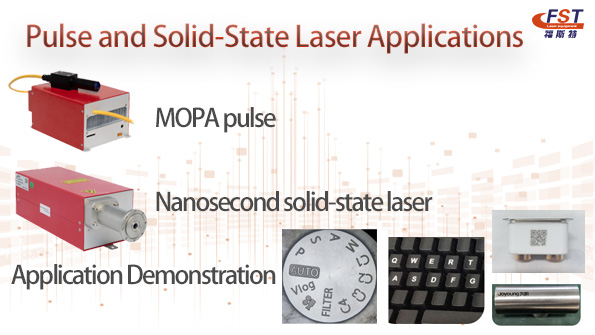
To further enhance technical capabilities and application proficiency, Foster Laser invited the technical team from JPT to conduct a specialized training session. The training provided a systematic explanation of the principles, product series, and typical applications of MOPA pulse lasers cleaning machine and nanosecond solid-state lasers, fully supporting the sales and technical teams in deepening their understanding of the products.
First Technical Overview of MOPA Pulse Lasers
MOPA (Master Oscillator Power-Amplifier) is a laser system consisting of an LD-seeded source driven by electrical pulses and a fiber amplifier. Current product lines include LP, M7, M8, and CL series, covering a power range of 20W to 2000W in mass-produced models.
Key characteristics:
Higher pulse energy alters the beam mode.
M7 is single-mode, while the CL series is mostly multi-mode except for the CL-1, which is single-mode.
Second Applications of MOPA Pulse Lasers (20W / 30W / 60W M7)
1.Deep Metal Engraving
High pulse energy ensures fast deep engraving
Fine high-frequency texture for better surface detail
2.Acrylic Paint Removal
Removes surface paint with smooth edges and excellent light transmission
Removes surface coatings while preserving engraved patterns
3.Stainless Steel Coloring
Pulse width and frequency are independently adjustable
Multiple parameter combinations produce rich color variations
4.Plastic Bitmap Marking
Suitable for marking plastic bitmaps and non-metallic material logos or codes
5.Fish-Scale Pattern Marking
Used for smartphone mid-board laser engraving
Enhances surface aesthetics and improves material conductivity
Additional Applications:
High peak lasers for anodized layer removal with minimal deformation and good conductivity
Pulse galvanometer cutting: low equipment entry barrier, easy optical component integration; ideal for thin metal sheet cutting
Third Nanosecond Solid-State Lasers
Nanosecond solid-state lasers use a solid crystal as the gain medium. Current product series include Seal, Lark, and Sparrow, with 0.8W–30W UV sources and 2W–40W green sources.
Fourth Customizable Energy Density Distribution
Multiple spatial energy distribution modes available: Gaussian or flat-top
Shape options: circular or square
Single-mode (Gaussian) beam: conical shape
Multi-mode (flat-top) beam: softer, minimal substrate damage, ideal for surface cleaning
Fifth Features and Advantages of UV Lasers
Characteristics:
Short wavelength, easy to focus, high energy concentration, high resolution
Advantages:
High processing precision
Narrow line width
Excellent beam quality
Minimal heat-affected zone
Applications:
Fine microfabrication, high-precision drilling, cutting, and grooving
Successfully applied on metals, semiconductors, ceramics, glass, and various polymers
Sixth Applications of Nanosecond Solid-State Lasers (3W / 5W / 10W)
1.PCB Processing
Applied in medical devices, industrial equipment, lighting, automotive, and 3C electronics
2.QR Code and Character Marking on Circuit Boards
Ensures product traceability
Supports automation and intelligent management
3.Clear and Readable QR Codes
4.Plastic and Non-Metallic Daily Products Marking
UV processing is considered “cold processing,” allowing nearly all plastics and polymers to achieve ideal marking results
5.Removal of Stubborn Coatings
Short wavelength, high beam quality, and high peak power density
Easily removes paint, adhesive, or plating layers cleanly and efficiently
Seventh Training Outcome
Through this JPT technical training, the Foster fiber Laser team achieved a systematic enhancement in understanding laser principles, product selection logic, and process application capabilities.Moving forward, the company will continue to deepen technical cooperation with industry-leading enterprises, continuously optimize product solutions and service capabilities, and providecustomers with more efficient, stable, and professional laser application solutions.
Post time: Apr-08-2026

