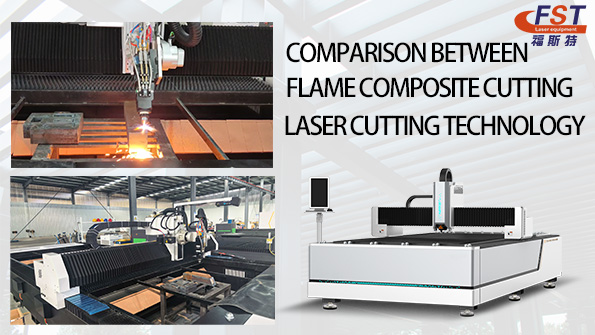
In the field of heavy plate metal processing, both flame composite cutting and laser cutting are essential manufacturing technologies. As the manufacturing industry continues to demand higher cutting quality, improved processing efficiency, and lower production costs, the advantages and limitations of different cutting methods have become increasingly apparent in practical applications. For medium-thick and ultra-thick plate processing, flame composite cutting remains highly valuable due to its stability, cost efficiency, and strong processing capability.
Core Advantages of Flame Composite Cutting
Compared with conventional laser cutting processes, flame composite cutting offers more significant advantages in thick plate applications in terms of both cost control and process adaptability.
First, during the processing of ultra-thick metal plates, flame composite cutting can effectively reduce overall cutting costs. Especially in carbon steel and thick steel plate processing, flame cutting demonstrates higher gas and energy utilization efficiency. While maintaining strong cutting performance, it significantly lowers operating costs, making it particularly suitable for large-scale thick plate production.
Second, flame composite cutting features simpler process adjustment and stronger equipment adaptability. Compared with laser cutting, which requires precise control of focus position, laser power, gas pressure, and parameter matching, flame composite cutting provides a wider process window and lower sensitivity to operator experience and environmental variations. This helps improve equipment stability and ensures continuous production efficiency.
In addition, flame composite cutting delivers more stable cross-sectional cutting quality in thick plate applications. When processing heavy steel plates, it can achieve smoother and more uniform cutting surfaces while offering advantages in slag control, verticality, and heat-affected zone management. Particularly in high-thickness material processing, its cutting performance often exceeds that of standalone laser cutting technology.
Characteristics of Laser Cutting
Laser cutting is widely recognized for its high precision, high cutting speed, and advanced automation capabilities. With narrow kerf width and minimal heat-affected zones, it is especially suitable for precision component manufacturing and complex contour cutting in thin and medium-thin metal sheets.
However, when processing thick materials, laser metal cutting machine requires significantly higher laser power, auxiliary gas consumption, and stricter parameter control. As a result, both operating and maintenance costs increase substantially. Furthermore, as material thickness increases, cutting efficiency and edge quality may gradually decline.
Application Value of Flame Composite Cutting
Overall, flame composite cutting is better suited for medium-thick and ultra-thick plate processing applications. It is widely used in industries such as heavy laser equipment manufacturing, steel structure fabrication, construction machinery, shipbuilding, and large-scale industrial equipment production, where high stability and strong cutting capability are essential.
Although flame composite cutting equipment generally involves higher initial investment and maintenance costs, its superior stability, broader process adaptability, and excellent thick plate cutting performance continue to make it a preferred solution for many industrial manufacturers.
Looking ahead, with the continuous advancement of intelligent control systems and hybrid processing technologies, the integrated application of flame composite cutting and laser cutting is expected to further drive the metal processing industry toward higher efficiency, greater precision, and improved production quality.
Post time: May-20-2026

