In handheld welding applications, the design of the control panel and display directly determines operational efficiency, adaptability, and safety.
This is especially critical when considering two common working conditions—operation with gloves and without gloves—where thoughtful design details play a decisive role.
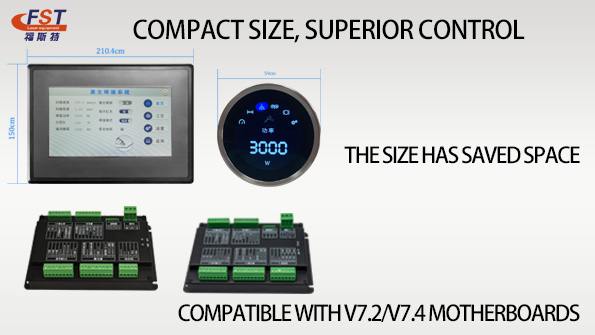
The newly upgraded handheld metal welding machine rotary screen, featuring a compact 1.6-inch form factor, breaks away from the spatial limitations of traditional 7-inch displays.
Combined with a user-friendly rotary control panel, it accommodates diverse operating scenarios, supports multiple machine models, and integrates intelligent remote control capabilities,delivering a comprehensive upgrade to the handheld welding experience.
Compared to conventional 7-inch screens, the most significant advantage of the 1.6-inch rotary display lies in its exceptional space efficiency. Portability and flexibility are core requirements for handheld welding laser equipment. Oversized screens not only increase the overall machine footprint but can also hinder maneuverability in confined workspaces.
In contrast, the compact1.6-inch design retains essential display functionality while significantly reducing space occupancy, resulting in a lighter and more compact system. It is well-suited for complex welding environments, including elevated operations, narrow workstations, and mobile tasks, allowing operators to handle and control the equipment with greater ease while effectively reducing fatigue during prolonged use.
Moreover, the screen offers strong compatibility, directly supporting V7.2/V7.4 control boards and widely applicable to [28F/T], 31F, and 33T series handheld welding machines.
This enables seamless integration with both new and existing equipment without additional modifications, reducing upgrade costs and ensuring smooth transition across systems.
In welding operations, operators often wear heat-resistant and cut-resistant gloves for safety. Traditional control panels frequently suffer from small buttons and unclear tactile feedback,leading to misoperations and reduced usability when gloves are worn. The upgraded rotary control panel addresses these issues by adopting industrial-grade dimensions and optimized damping design.
The knob surface features anti-slip texturing to enhance friction, allowing smooth and precise parameter adjustment even when wearing heavy-duty gloves.
This minimizes the risk of accidental input, ensures parameter stability, and ultimately improves welding quality and operational efficiency.
The addition of remote control functionality further enhances operational flexibility. Through a mobile application, operators can remotely start or stop the equipment and adjust welding parameters without being physically close to the worksite.
This not only helps avoid exposure to high temperatures, sparks, and other safety hazards but also significantly improves convenience.
It is particularly beneficial for large workpiece welding and elevated operations, where on-site control may be challenging. Operators can complete all tasks from a safe distance while maintaining both safety and efficiency. Additionally, real-time alarm notifications provide clear visibility of equipment status, enabling rapid response to abnormal conditions.
From space optimization to refined operational details, from glove-friendly interaction to intelligent remote control, this 1.6-inch rotary screen represents more than a simple size reduction—it is a systematic upgrade of the handheld welding experience. With its compact structure, precise control, and intelligent interface, it empowers users to maintain high efficiency and safety even in complex working conditions. As welding equipment continues to evolve toward greater intelligence and lightweight design, solutions that balance practicality with innovation are set to definethe future of handheld welding.
Post time: Mar-20-2026

