Integrating Laser and Flame Cutting for Intelligent High-Efficiency Plate Processing
As the metal fabrication industry continues to move toward higher precision, greater efficiency, and intelligent manufacturing, the limitations of traditional flame cutting technology are becoming increasingly evident. In applications such as thick plate piercing, complex bevel cutting, and high-speed thin sheet processing, manufacturers now require greater process stability, cutting consistency, and automation capability.
Driven by these industry demands, Bochu laser head flame composite cutting technology has become an important advancement in medium and thick plate processing. Through the integration of Bochu control systems and laser head technology, Foster Laser has continuously optimized flame composite cutting applications, enabling the transition from conventional flame cutting toward intelligent and digitalized manufacturing.
What Is Flame Composite Cutting Technology?
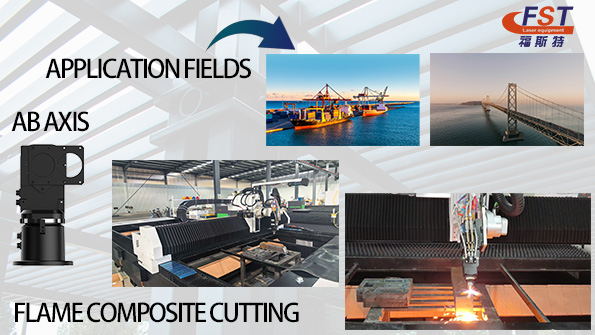
Flame composite cutting is an advanced processing method that combines traditional oxy-fuel flame cutting with laser-assisted output.
Traditional flame cutting relies on a high-temperature flame generated by fuel gas and oxygen to preheat the material before cutting. During operation, technicians must continuously adjust:
Flame shape
Flame intensity
Gas ratio
Piercing time
Cutting speed
As a result, laser metal cutting machine quality heavily depends on operator experience, and inconsistencies between operators can directly affect production quality.
Bochu laser head flame composite cutting technology introduces laser-assisted preheating and controlled energy output into the cutting process, enabling more precise thermal control during piercing and cutting operations. This significantly improves process parameterization, automation, and overall cutting consistency.
In practical applications at Foster Laser, flame composite cutting technology has demonstrated significant advantages in both thick and thin plate processing, while improving cutting stability and production efficiency.
Core Advantages of Bochu Laser Head Composite Cutting
1. Parameterized Processes Reduce Dependence on Manual Experience
Traditional flame cutting is highly dependent on operator skill and experience.
Factors such as:
Unstable flame adjustment
Incorrect piercing timing
Gas ratio fluctuations
Inconsistent cutting speed
can all directly impact cutting quality.
By integrating the Bochu control system with the laser head, the process becomes highly automated through:
Automatic cutting parameter matching
Intelligent piercing process control
Adaptive laser output adjustment
Standardized production workflows
In Foster Laser’s composite cutting solutions, optimized process databases enable the machine to automatically match parameters for different plate thicknesses and materials, significantly reducing manual intervention while improving batch production consistency.
2. Improved Thick Plate Piercing Stability
In conventional flame cutting, thick plate piercing is often time-consuming and prone to excessive slag generation or piercing failure.
With laser-assisted output:
Energy is concentrated more efficiently
Preheating time is reduced
Piercing speed is increased
Cutting interruption risks are minimized
For medium and thick plate applications, this greatly enhances cutting stability and continuous production capability.
Through the coordinated integration of Bochu laser heads and intelligent control systems, Foster Laser has achieved more stable thick plate piercing performance while reducing secondary grinding and rework costs.
3. Significantly Higher Efficiency for Thin Plate Processing
Traditional flame cutting is primarily designed for thick plate applications and often struggles with thin sheet processing due to:
Thermal deformation
Rough cutting edges
Excessive kerf width
Low processing efficiency
By adding laser-assisted output, flame composite cutting enables rapid preheating and faster cutting initiation, dramatically improving thin sheet cutting performance.
Additional benefits include:
Smaller heat-affected zones
Smoother cutting surfaces
Higher dimensional accuracy
This makes the technology especially suitable for modern manufacturing environments requiring multi-specification, small-batch, and high-efficiency production.
4. Enhanced Precision with AB Axis Bevel Cutting
As industries such as steel structure fabrication, shipbuilding, and heavy machinery manufacturing continue to demand higher welding quality, the need for complex bevel cutting has increased significantly.
When integrated with AB axis linkage systems, Bochu laser heads enable:
Multi-angle bevel cutting
Complex contour machining
Three-dimensional structure processing
High-precision weld bevel formation
Foster Laser has deeply integrated AB axis systems with composite cutting technology, allowing laser equipment to achieve superior precision and adaptability when processing complex structural components.
Comparison Between Flame Composite Cutting and Traditional Flame Cutting
Traditional Flame Cutting
Advantages
Lower equipment investment
Mature and widely adopted technology
Strong thick plate cutting capability
Limitations
Heavy reliance on operator experience
Poor parameter consistency
Limited automation
Lower efficiency for thin plate processing
Larger thermal deformation
Bochu Flame Composite Cutting
Advantages
Laser assistance improves piercing efficiency
Process parameters become fully digitized
Enhanced capability for both thick and thin plates
More stable cutting quality
Improved machining precision with AB axis integration
Better compatibility with intelligent manufacturing systems
Limitations
Higher equipment investment compared to traditional flame cutting
Increased maintenance requirements for laser systems
More complex multi-gas parameter management
Higher demands on equipment management and technical support
However, from a long-term production perspective, composite cutting offers significant advantages in productivity, product consistency, and labor cost reduction.
Future Development Trends in Intelligent Composite Cutting
With the rapid advancement of smart manufacturing, flame composite cutting technology is evolving toward:
Automatic process optimization
Intelligent parameter matching
AI-driven process databases
High-precision bevel cutting
Unmanned and automated production
Foster Laser continues to promote the integration of Bochu systems with intelligent cutting technologies, further optimizing comprehensive thick and thin plate processing solutions for global customers.
Conclusion
Bochu laser head flame composite cutting technology combines the thick plate processing capability of traditional flame cutting with the high efficiency and precision of laser cutting.
Compared with conventional flame cutting, composite cutting offers:
More intelligent process control
Standardized and digitalized parameters
Higher production efficiency
Greater cutting stability
Superior capability for complex machining
Although equipment investment and maintenance requirements are relatively higher, flame composite cutting is becoming an essential upgrade path for the metal fabrication industry in the era of intelligent manufacturing and high-end equipment production.
Looking ahead, Foster Laser will continue advancing composite cutting technology and intelligent manufacturing solutions, helping customers achieve higher efficiency, greater precision, and smarter production capabilities.
Post time: May-14-2026

