If you are shopping for a laser cleaning machine, you will see two main options: pulsed and continuous (CW). They sound similar, but using the wrong one on a customer’s part can destroy your processing efficiency or heat-distort the metal.
Here is the real breakdown from the shop floor.
Cleaning precision parts without distortion
A pulsed laser fires short, high-energy bursts, usually under 100 nanoseconds (ns). Because the beam hits the surface and stops instantly, the heat doesn’t have time to bleed into the metal.
If you are cleaning precision tooling, injection molds, or thin automotive body panels, you need a pulsed fiber laser cleaning machine. At a high frequency of 20–100kHz, it vaporizes mill scale and oil residues cleanly. The big benefit is that the metal stays cold to the touch, meaning you won’t warp a 1.5mm stainless steel sheet. The trade-off is speed: pulsed systems are built for accuracy, not for stripping large square footage quickly.
Chewing through heavy corrosion on thick plate
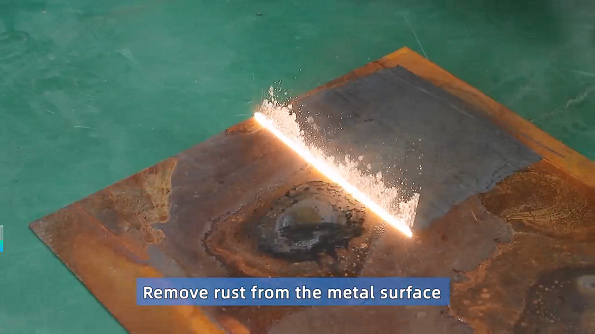
Continuous lasers (CW) emit a steady, uninterrupted beam of light. This constant output creates massive heat accumulation at the surface, which is exactly what you need for bulk scaling.
If you have a 1000W to 3000W continuous setup, you can clear heavy rust and marine coatings at speeds up to 30m²/h. But if you take that same CW machine and try to clean a thin 2mm aluminum bracket, the intense heat will distort the metal or discolor the surface. For a 20mm structural I-beam or thick storage tank, however, CW is the only option that makes economic sense.
How to choose for your workload
Before buying, look at your daily job tickets and check three things:
• Metal Gauge: Anything under 3mm requires the low heat input of a pulsed machine. For plates over 6mm, continuous wave wins.
• The Contaminant: Light surface rust and oils peel off easily with a 100W–300W pulsed laser. Thick, multi-layered industrial paint and scale demand the raw power of a 2000W CW system.
• The Finish: If the part requires a mirror finish or strict dimensional tolerances after cleaning, pulsed is your only choice.
The bottom line
Pulsed gives you precision control but takes longer on large parts. Continuous gives you raw speed but will burn thin materials.
If you want to see how these power configurations handle your specific jobs, check our full fiber laser cleaning machine catalog to compare the scan widths, spot sizes, and air-cooled vs. water-cooled setups for each model.
Post time: Oct-09-2026

